
Wallenius Wilhelmsen to Build World’s Largest Car Carriers with Upsized Design
Amid surging demand and the need to enhance operational efficiency and reduce environmental impact, the car carrier sector is undergoing a shift toward a new generation of larger, more efficient vessels. Today, Wallenius Wilhelmsen, a leader in the industry, announced its plans to build the world’s largest capacity pure car and truck carriers (PCTCs), further expanding its fleet to meet this growing demand.
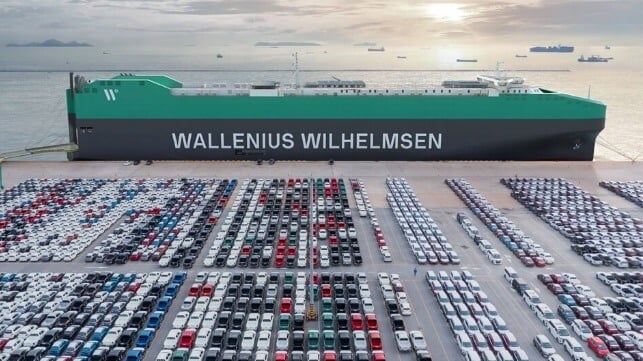
The company will enlarge four of the 12 vessels it has on order from China’s Jinling Shipyard, with deliveries starting in 2026. Earlier this year, Wallenius Wilhelmsen revealed the order for 12 ships, each with a capacity to transport 9,300 vehicles, emphasizing their enhanced efficiency and reduced environmental footprint. The final four vessels in the series will see their capacity increased by 25 percent, enabling them to transport 11,700 vehicles, making them the largest PCTCs ever constructed.
Until recently, the sector’s largest carriers had a maximum capacity of 8,500 units. In August 2023, Höegh Autoliners introduced Höegh Aurora, boasting a capacity of 9,100 units. Additionally, CSSC unveiled its new design capable of transporting 10,800 vehicles, with Seaspan ordering six of these vessels for charter to Hyundai Glovis. Meanwhile, China Merchants gained Approval in Principle for an 11,000-unit design.
Wallenius Wilhelmsen expects the first of its upsized 11,700-unit vessels to be delivered by late 2027. The company highlights that the increased capacity will not only lower operating costs but also support its ambitious net-zero emissions goals.
“These new Shaper vessels are specifically designed for our operations and trading patterns, fully prepared for net-zero from the start and built with significant economies of scale,” stated Xavier Leroi, EVP & COO of Shipping Services at Wallenius Wilhelmsen. “They offer exceptional fuel savings and emissions reductions, in addition to unparalleled cargo capacity and the highest ramp strength in the industry, making them a true game-changer for the future of shipping.”
When the vessel class was first announced, Wallenius Wilhelmsen highlighted their designs for alternative fuels, such as methanol and ammonia. The vessels will also be equipped with shore power capabilities and a battery system to optimize power generation, reducing energy use during maneuvering. Additional sustainability features include solar panels and air lubrication systems to enhance hull performance.
The vessels’ hull form has been optimized for both cargo handling and energy efficiency. Two of the four movable decks will be electrically hoistable, while enhanced fire safety measures include the introduction of two fire zones, surpassing current regulatory requirements.
With competition increasing, companies are racing to add new features to stand out. This year, industry giants CMA CGM and MSC Mediterranean Shipping entered the vehicle transport market, while Chinese car manufacturers, faced with capacity shortages, launched their first dedicated vessels. Vehicle transport remains one of the fastest-growing segments in the shipping industry.
Moving The Sea With Us!
Contact us today: +351 265 544 370 or go to Contacts Page
Email: sales@partyard.eu
#PartYard #PartYardMarine #ShippingIndustry #WalleniusWilhelmsen #CarCarriers #PCTC #SustainableShipping #NetZero #AlternativeFuels #BatterySystems #VehicleTransport #JinlingShipyard #ShorePower #ShipDesign #AmmoniaReady #FuelEfficiency #CMA_CGM #HyundaiGlovis #MaritimeTechnology #MovingTheSeaWithUs

