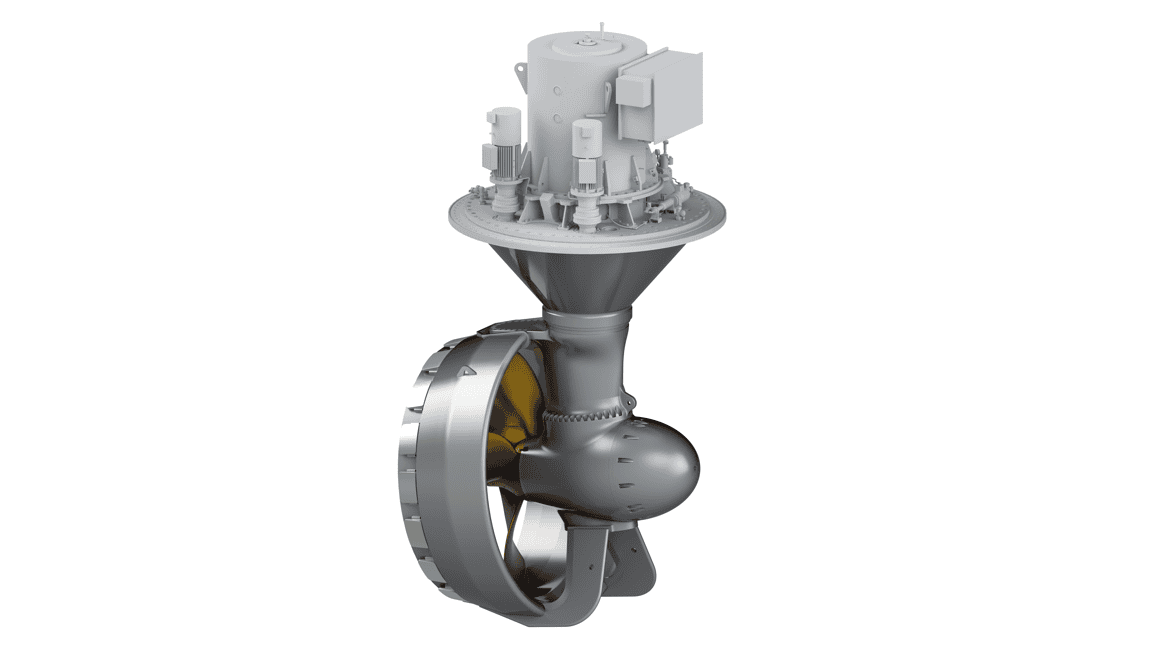
The enhanced performance of the SCHOTTEL RudderPropeller Dynamic (SRP-D) has been reaffirmed through external evaluations. At the request of the Dutch Damen Group, the Maritime Research Institute Netherlands (MARIN) conducted comprehensive research to assess the benefits of the SRP-D for Commissioning Service Operation Vessels (CSOVs).
Improved Propulsion Efficiency
While earlier studies had highlighted reduced DP footprint and fuel savings, Damen’s latest research specifically examined propulsion efficiency during thruster interactions. Results confirmed a notable increase in thrust yield and reduced forbidden zones compared to conventional rudder propellers.
Mark Couwenberg, Product Portfolio Manager for SOVs at Damen, stated:
“In our continuous strive for offering optimal vessels to our clients, SCHOTTEL’s developments are a great step. The SRP-D thrusters mounted under Damen’s optimized hulls result in vessels with a smaller footprint while at the same time reducing fuel use and further improving comfort on board. Combined with SCHOTTEL’s robust methods of design, engineering, and construction, we are convinced that our clients will have life-long benefits by selecting this combination.”
Higher Positioning Accuracy
The SRP-D, designed for Dynamic Positioning (DP) operations, meets growing demands for efficiency and reliability in CSOVs. It features:
- An eight-degree tilt of the lower gearbox.
- A vertically integrated electric drive motor (LE-Drive).
- Reduced propeller acceleration/deceleration times.
These innovations, combined with a high-speed azimuth steering system and reinforced gear components, enable faster thrust allocation and shorter response times. This allows vessels to react more effectively to external forces, such as wind and currents, ensuring higher positional accuracy.
Testing in Offshore Basin
The MARIN study tested a CSOV model equipped with a SCHOTTEL SRP-D on the starboard side and a 90-degree rudder propeller on the port side. Conducted in a 45-meter by 36-meter offshore basin, the research involved calibrated sensors measuring thruster and hull interactions.
Key findings included:
- The eight-degree tilt of the SRP-D propeller shaft reduced thrust losses significantly compared to the 90-degree thruster.
- Only 10% thrust losses in transverse direction for the SRP-D, versus 35% for the 90-degree thruster.
- During propeller flow interactions, thrust losses were also markedly lower for the SRP-D:
- 20% in-line thrust losses compared to 50% with 90-degree thrusters.
- 20% transverse thrust losses, versus 40% with 90-degree thrusters.
These results highlight the minimized Coandă effect with the SRP-D, further improving performance.
Fuel Efficiency and Year-Round Safety
The SRP-D’s optimized design significantly enhances thrust yield and distribution by minimizing interactions between thrusters and the hull. As a result:
- Forbidden zones are reduced, improving Dynamic Positioning performance.
- CSOVs achieve lower fuel consumption and higher efficiency, allowing for safer operations throughout the year.
With these advancements, SCHOTTEL has demonstrated its commitment to providing cutting-edge propulsion solutions that meet the evolving needs of the maritime industry. The SRP-D’s performance ensures vessels operate efficiently, safely, and sustainably, benefiting both ship operators and the environment.
Moving The Sea With Us!
Contact us today: +351 265 544 370 or go to Contacts Page
Email: sales@partyard.eu
#MarineTechnology #RudderPropeller #SCHOTTEL #EfficiencyInnovation #ThrusterTechnology #SustainableShipping #FuelEfficiency #MaritimeEngineering #DynamicPositioning #OffshoreVessels #CSOV #DPThrusters #NavalInnovation #ShipEfficiency #AdvancedPropulsionSystems #ThrustOptimization

