
Brunsbüttel Ports: Essential Pillar for Germany’s Energy Supply Security
Brunsbüttel Ports are set to play a critical role in Germany’s energy supply security, contributing significantly to the nation’s climate goals.
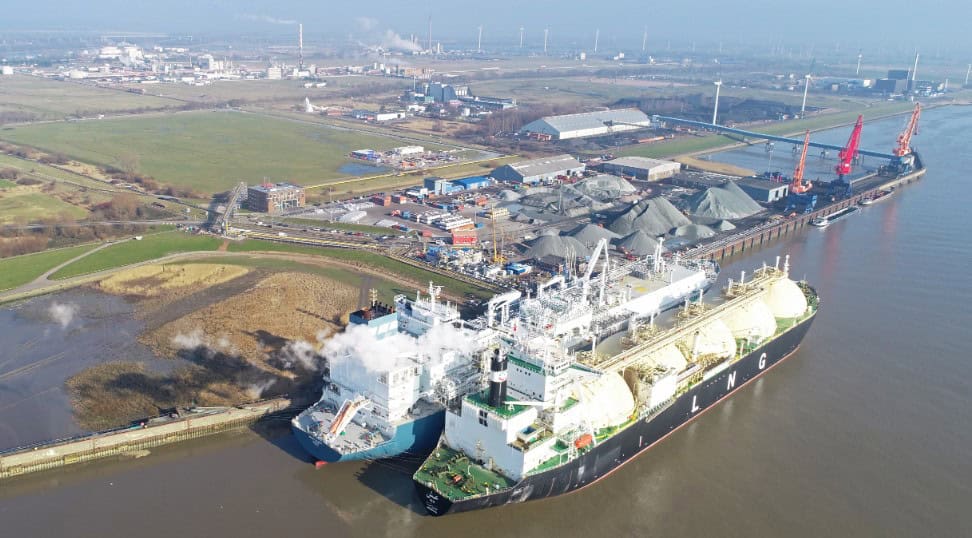
The Brunsbüttel port complex—Elbehafen, Oilport, and Port of Ostermoor—provides direct access to both the North Sea and Baltic Sea, as well as to European inland waterways. Together, these three ports form “an essential pillar for nationwide energy supply security,” with the Elbehafen deep-water port being central, especially as it became a national hub for LNG imports during the recent energy crisis.
Looking ahead, the energy import infrastructure will also support green energy imports. Last year, the European Commission approved €40 million in support for a land-based LNG terminal in Brunsbüttel, set to replace the current FSRU by 2026 with a capacity of 10 billion cubic meters for import, storage, and distribution.
In October, Norwegian ammonia trade leader Yara International inaugurated a new ammonia import terminal in Brunsbüttel, capable of bringing up to three million tonnes of low-emission ammonia to Europe each year—equivalent to 530,000 tonnes of hydrogen or around 5% of Europe’s 2030 hydrogen target. This low-emission ammonia, produced using renewable electricity or carbon capture and storage (CCS), serves as a decarbonization solution for hard-to-abate sectors.
Furthermore, Brunsbüttel’s Elbehafen port is anticipated to play a key role as an export hub for CO2 in support of planned CCS projects, marking another major step toward climate objectives.
Significant investments are being directed at Brunsbüttel to advance industry decarbonization and energy transition initiatives, with the area aiming to lead the way as Germany’s first climate-neutral federal state.
This week, all eyes are on Brunsbüttel as it hosts the annual Energy Ministers’ Conference (EnMK) from November 6 to 8. The conference agenda includes renewable energy and hydrogen economy advancements, alongside industry transformation needs—such as expanding connections to offshore wind farms and digitizing the energy grid for a sustainable future, as detailed by Brunsbüttel ChemCoast Park, Schleswig-Holstein’s largest industrial hub.
“As ChemCoast Park, we are pioneers for green energy in the north. Through numerous energy policy projects, especially those by leading chemical companies, it’s clear that Brunsbüttel is a beacon of the energy transition,” said Frank Schnabel, Spokesman for ChemCoast Park. He added, “We’re particularly proud to showcase this to representatives from other federal states in the coming days. As part of our program, we’ll be demonstrating our floating LNG terminal and energy import infrastructure live from Brunsbüttel’s Elbe harbor.”
Moving The Sea With Us!
Contact us today: +351 265 544 370 or go to Contacts Page
Email: sales@partyard.eu
#PartYard #PartYardMarine #BrunsbüttelPorts #EnergySecurity #GreenEnergy #ClimateGoals #LNGImport #EnergyTransition #RenewableEnergy #AmmoniaImport #HydrogenEconomy #CarbonCapture #CCS #ChemCoastPark #SustainableShipping #GermanIndustry #Decarbonization #EnergyHub #EnergyMinistersConference #NorthSea #BalticSea #Digitization #OffshoreWind #MovingTheSeaWithUs

