
Offshore Charging System for Service Vessels Tested at Belgian Wind Farm
Parkwind, a developer of offshore wind farms owned by Japan’s JERA, has successfully completed the first test of an offshore charging station that supplies power from the wind farm to service vessels. This innovative technology, developed by several companies, promises to enable crew and maintenance vessels to operate using renewable energy sourced directly from the wind farm.
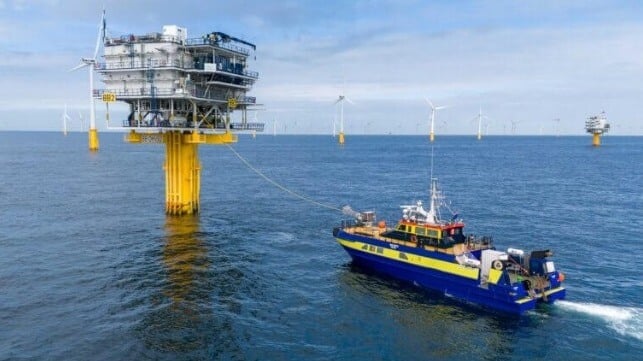
Proponents of this concept highlight its potential to facilitate the use of electric-powered, emission-free vessels in supporting wind farms. One of the current challenges is that as wind farms are situated further offshore, they exceed the storage capacity of current batteries to safely operate the vessels.
Developed by UK-based MJR Power & Automation, the system was tested at the Nobelwind wind farm, located approximately 30 miles offshore in the Belgian North Sea. In operation since 2017, this wind farm comprises 50 turbines.
The charging system was transported to the offshore substation aboard one of the CTV vessels and assembled within two days using the substation crane. The setup was successfully tested, achieving the first transfer of power to a CTV from a fully operational and producing offshore wind farm.
“This is a game changer for our maintenance vessels, which can now access green energy directly from our wind turbines as they carry out their work,” said Kristof Verlinden, Head of O&M at Parkwind. “The trial proved the system can transfer electricity from a wind farm to the vessels safely without any disruption to the farm.”
Parkwind emphasized the ease of use of the system, which features an automatic coupling and uncoupling process. This allows ships to connect to the charging cable and remain in place while charging, despite sea currents.
MJR Power & Automation managed all electrical and mechanical interface engineering to install the system on the substation, while Parkwind provided offshore logistics, installation, testing support, and the electrical power interface.
The system is designed for CTV charging up to 2MW and SOV charging up to 8MW. It can also supply offshore power to other conventional offshore vessels on standby, thereby reducing their emissions from diesel generators.
MJR plans to incorporate lessons learned from these trials into the first commercial offshore charging system delivery, scheduled for Q1 2025.
Moving The Sea With Us!
Contact us today: +351 265 544 370 or go to Contacts Page
Email: sales@partyard.eu
#PartYard #PartYardMarine #OffshoreCharging #RenewableEnergy #Parkwind #WindFarm #GreenEnergy #ElectricVessels #MJRPowerAutomation #SustainableShipping #MovingTheSeaWithUs

